Every business develops its own way of working. One company may rely heavily on sales follow-ups, while another may need detailed project tracking, customer support or automated financial processes. The problem starts when standard software does not quite match those requirements.
Instead of changing the entire business process to fit a software platform, customization can allow the technology to fit the way the business actually operates. For companies using Zoho applications, Zoho customization in Abu Dhabi can help turn standard tools into workflows that are better suited to specific operational needs.
Ready-made software is designed to serve a broad range of users. That makes it practical, but it also means some businesses may find that certain features do not perfectly match their processes.
For example, a sales team might need a particular approval process before a quotation can be sent. Another business may need customer information to move automatically between sales, support and other departments.
Without customization, employees may end up maintaining separate spreadsheets, sending manual emails or repeatedly entering the same information.
Over time, these small inefficiencies add up.
Customization can help reduce unnecessary manual steps by adapting the software around established business workflows.
The scope depends on the applications a business uses and what it wants to achieve.
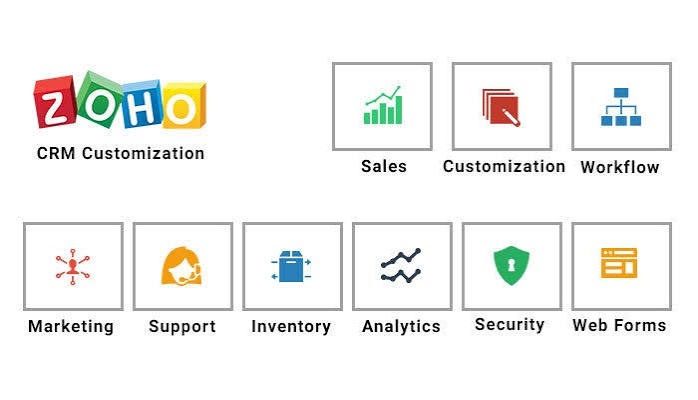
Common customization requirements can include modifying CRM fields, creating custom modules, developing automated workflows, setting up approval processes and building reports or dashboards.
Businesses may also require integrations between Zoho and other applications. For instance, customer information collected through a website could potentially be connected to a CRM workflow, reducing the need for employees to transfer information manually.
The goal should always be practical. Customization is most useful when it solves a genuine business problem rather than simply adding more features.
Repetitive administrative work is one of the easiest areas to improve.
Imagine a sales employee entering a new customer into a CRM. That customer may need a welcome email, an assigned salesperson, a follow-up task and a status update. If every step has to be completed manually, employees spend time performing routine actions.
Automated workflows can handle suitable tasks based on predefined conditions.
For example, a particular customer status could automatically create a follow-up task for a salesperson. An approved request could trigger the next stage of an internal process.
Automation does not remove the need for employees to make decisions. Instead, it can reduce the amount of routine work surrounding those decisions.
Customer information becomes more useful when it is organized and accessible.
A customized CRM environment can help businesses structure customer data according to their actual sales process. Different teams can have access to the information they need without forcing everyone to work with the same generic layout.
Businesses can also create dashboards that highlight relevant information, such as pending leads, sales opportunities, follow-ups or customer service activity.
For managers, this can make it easier to understand what is happening across the business without relying entirely on separate spreadsheets and manually prepared reports.
Many companies use several applications at the same time. Problems can arise when these systems do not communicate effectively.
A business might use one platform for its website, another for accounting, another for customer communication and Zoho applications for CRM or operations. If information has to be copied manually between systems, errors and delays become more likely.
Integration can help connect these systems where appropriate.
This is one area where Zoho customization in Abu Dhabi can provide practical value. Instead of forcing employees to repeatedly move information from one application to another, a customized setup can be designed around the organization's existing technology environment.
The exact integration approach depends on the applications involved, available APIs and the type of information being exchanged.
Customization should begin with business requirements, not with a list of technical features.
Before making changes, companies should identify where employees are losing time, where information is being duplicated and which processes regularly create errors or delays.
A simple process map can often reveal opportunities for improvement.
For example, if a quotation currently passes through four employees before approval, the business can examine each stage and determine whether some steps can be automated or simplified.
This approach helps prevent unnecessary customization and keeps the system easier to manage.
Customization is not limited to large organizations.
Small and medium-sized businesses can also benefit when a standard system does not match their workflow. However, the level of customization should be appropriate for the company's size and resources.
A small company may only need a few customized fields, workflows and reports. A larger organization with multiple departments may require more complex automation, integrations and permission structures.
Starting with the most important problems and expanding gradually is often more practical than attempting to customize everything at once.
Technical knowledge is important, but understanding the business process is equally valuable.
A good customization provider should first ask how the company operates, what applications employees currently use and where the main problems occur. Recommendations should then be connected to those requirements.
Businesses should also consider documentation and ongoing support. A customized system can become difficult to maintain if nobody understands why particular workflows or integrations were created.
Clear documentation can make future updates easier and reduce dependence on one individual who originally configured the system.
More customization does not automatically mean a better system.
Adding too many fields, complicated workflows or unnecessary automation can make software harder for employees to use. It can also increase maintenance requirements.
The best customization is often relatively invisible to the user. Employees simply notice that a task that previously required several steps now happens more naturally.
That is a useful benchmark: if customization makes everyday work clearer and easier, it is probably solving the right problem.
Business software should support the way an organization works rather than constantly forcing employees to work around the software.
For companies using Zoho applications, Zoho customization in Abu Dhabi can provide an opportunity to improve workflows, automate repetitive tasks, organize customer information and connect different business processes.
The strongest results usually come from starting with real operational challenges and then selecting the appropriate technical solution. Businesses do not need to customize everything. They need to customize the parts that genuinely affect productivity, customer service and decision-making.
When software is configured around the needs of the people using it every day, technology becomes much more than a collection of features. It becomes a practical part of how the business operates.

This post has been authored and published by one of our premium contributors, who are experts in their fields. They bring high-quality, well-researched content that adds significant value to our platform.











Canada Trends is your trusted source for trending news, lifestyle insights, business updates, technology developments, entertainment stories, and informative content from Canada and around the world.